52%
Less time to count
A handheld read of about 50 one-gallon containers took 5.1 seconds, against 10.6 seconds, in the companies’ own test.
 Discuss a requirement
 Handheld count · about 50 one-gallon containersStandard read 10.6 sGen2X read 5.1 s52% less time
Insight · RFID in retail · 9 minute read
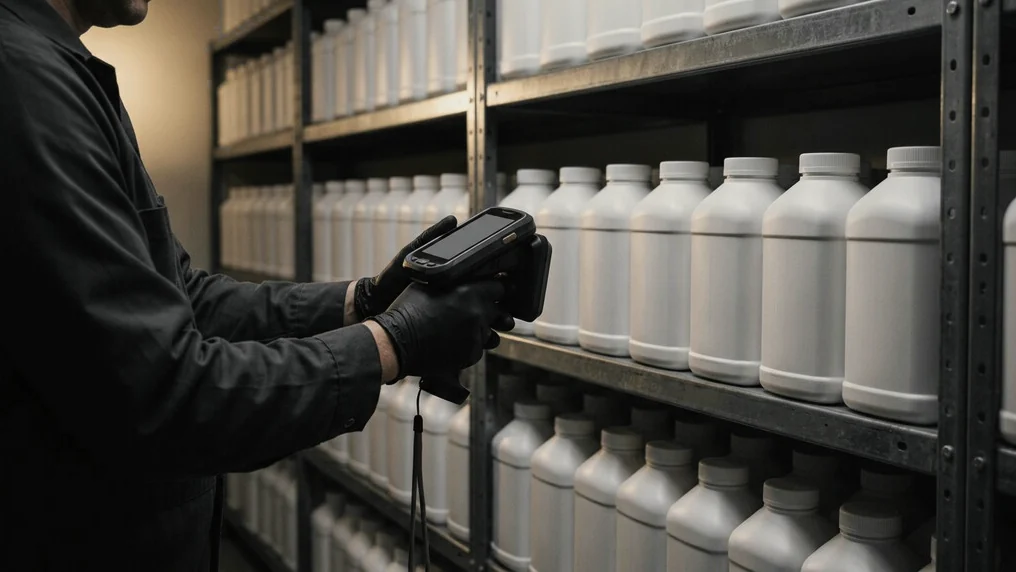
Liquids have always been one of the hardest products to identify with RFID. A new way of tagging them at the bottle cap has now been tested on one-gallon containers. This guide explains why liquids are hard, how the cap approach works, what the tests do and do not show, and how to check it on your own shelf.
In short
If you only have a minute, this is the summary. The rest of the page explains each point.
52%
A handheld read of about 50 one-gallon containers took 5.1 seconds, against 10.6 seconds, in the companies’ own test.
89%
A fixed reader at one metre read 89% of tagged items, against 74% with the standard mode.
3
Water absorbs radio energy, curved containers disturb the antenna, and metal shelving makes both worse.
1
From “can liquids be tagged?” to “where does the tag go, and who applies it?”
First, the basics
You do not need an engineering degree to judge this news. You need to understand one idea: a tag has to receive enough energy, and its antenna has to stay tuned.
Most tags used in retail stock counts are passive. They have no battery. A reader sends out a burst of radio energy, the energy powers the tiny chip in the tag for a moment, and the chip answers with its identity number. The reader hears the answer. This takes a fraction of a second, and a reader can hear many tags in a second.
The system most retailers use for this is called RAIN RFID, built on a standard known as Gen2. A tag only answers if two things are true. First, enough energy reaches it. Second, its antenna is tuned to the frequency the reader uses, like a radio set to the right station. A tag on a shirt, in open air, meets both conditions easily. That is why apparel was the first category retailers tagged.
Why liquids are hard
Each problem alone can be managed. On a store shelf, a liquid product often has all three at once.
Radio energy that reaches water is soaked up instead of passing on or bouncing back. A tag on or near a full container receives less energy than it would in open air, and its reply is weaker too. The reader may simply not hear it.
A tag antenna is designed for a particular surface. Wrapped around a round bottle or held close to liquid, it can slip off its frequency, so even the energy that arrives is not used well. Bottles and jugs do not give a tag a flat, predictable place to sit.
Metal reflects energy away from a tag and also changes how the antenna is tuned. Many store fixtures are metal, and dense packing, such as a case in the middle of a pallet of bottled water, stops the energy reaching the centre at all.
The result is a pattern most retailers know. Apparel is fully tagged. Health and beauty, food and household products stay outside the RFID programme, because tags that work on a shirt do not read reliably on a bottle. Specially designed tags exist for liquids and metal, but they cost more, so the real question for any application is whether the return justifies the cost, not whether a read is possible.
Situation
What happens to the read
What usually helps
Garment on a rail
Energy arrives and the antenna stays tuned. Reads are easy.
A standard tag.
Full liquid container
Water absorbs energy and detunes the tag.
Tag position away from the liquid, a design made for liquids.
Container on a metal shelf
Metal reflects energy and detunes the antenna.
A spacer or on-metal design, and testing on the real fixture.
Dense stack or pallet
Energy cannot reach tags in the middle.
Read as items move, or tag every case, not only the pallet.
The cap approach
Two technology companies have introduced an RFID inlay that sits in the shrink band on the bottle cap. It is applied during filling and capping, so the manufacturer does not have to redesign the label.
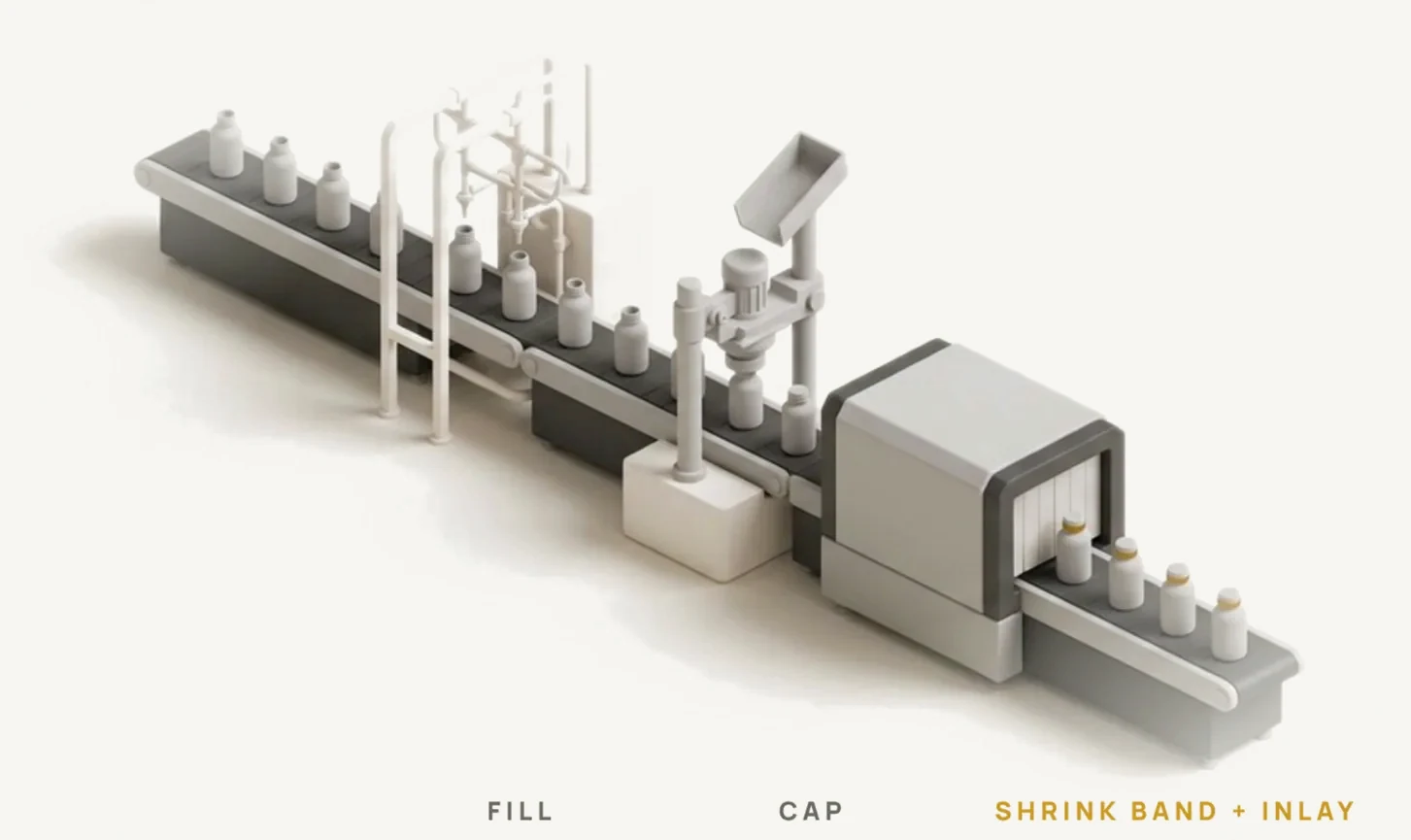
In the shrink band on the cap. At the top of the container, not wrapped around its liquid-filled body.
The manufacturer, during filling and capping. The retailer does not have to tag products in the store.
The label. The manufacturer adds the tag without redesigning the packaging.
Why this matters for a retailer: if the tag arrives on the product from the factory, the in-store labour of tagging liquids disappears. The open questions move to the supply side: which suppliers will apply it, and on which products.
The reader side
The tag is only half of the result. The tests used the newer Gen2X mode, which is an enhancement of the Gen2 standard, not a replacement for it.
Gen2X improves how well a reader hears weak replies and how well it delivers power to tags. That is what helps small tags, liquids and densely packed items.
It reduces the data tags send back and the errors in the exchange, so a reader can finish an inventory sooner.
It adds ways to focus on the tags you want, and a protected mode that controls when and where tags can be read.
Gen2X is not a new protocol. It works within the existing Gen2 standard (ISO 18000-63), and Gen2X and Gen2 are described as interoperable. The full gain, however, needs a Gen2X-enabled reader together with a chip that supports it. Older readers will still read the tags, but you should not expect the same improvement from them. This is the first thing to ask about before planning around the headline numbers.
The tests
Both tests were run by the companies that make the product. They show the direction of the improvement. They do not promise what your store will see.
Test set-up: about 50 one-gallon liquid containers, each with the cap inlay. The first test used a handheld reader with Gen2X support. The second used a fixed reader one metre away, with a five-second read.
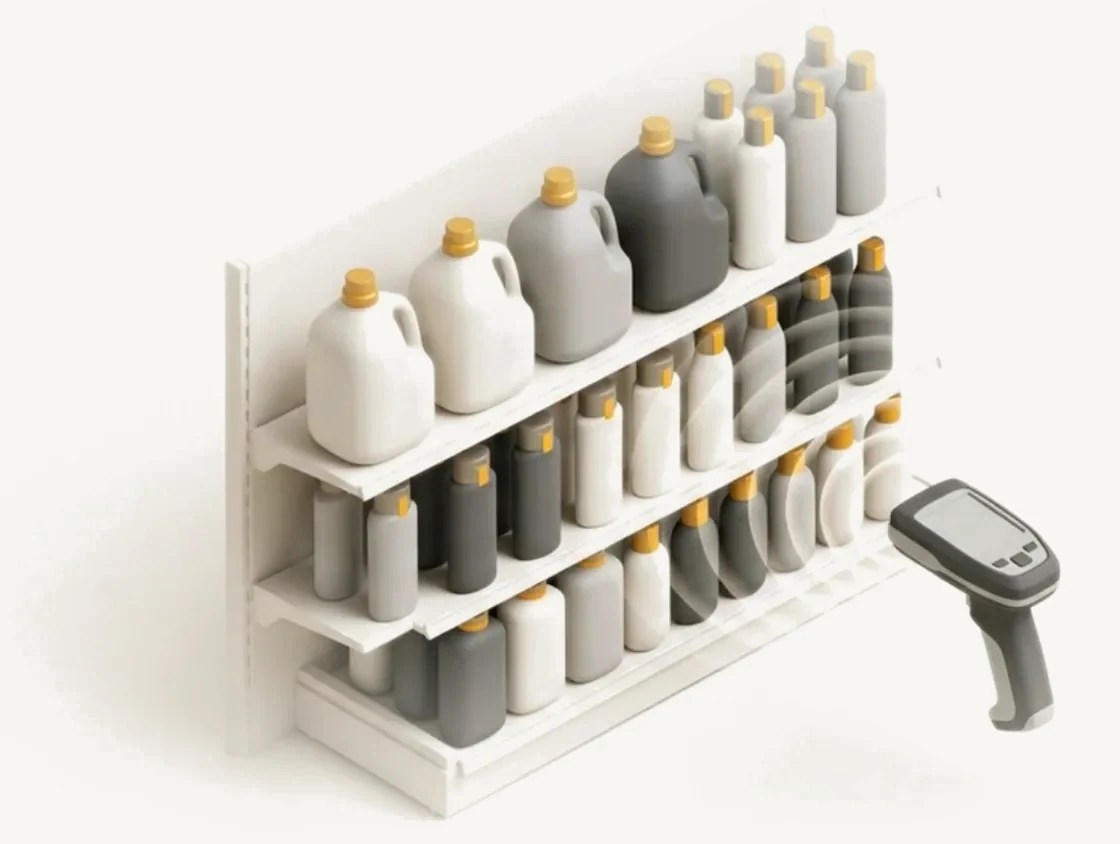
Handheld: time to count about 50 containers
52% less time. Source: the companies’ own test.
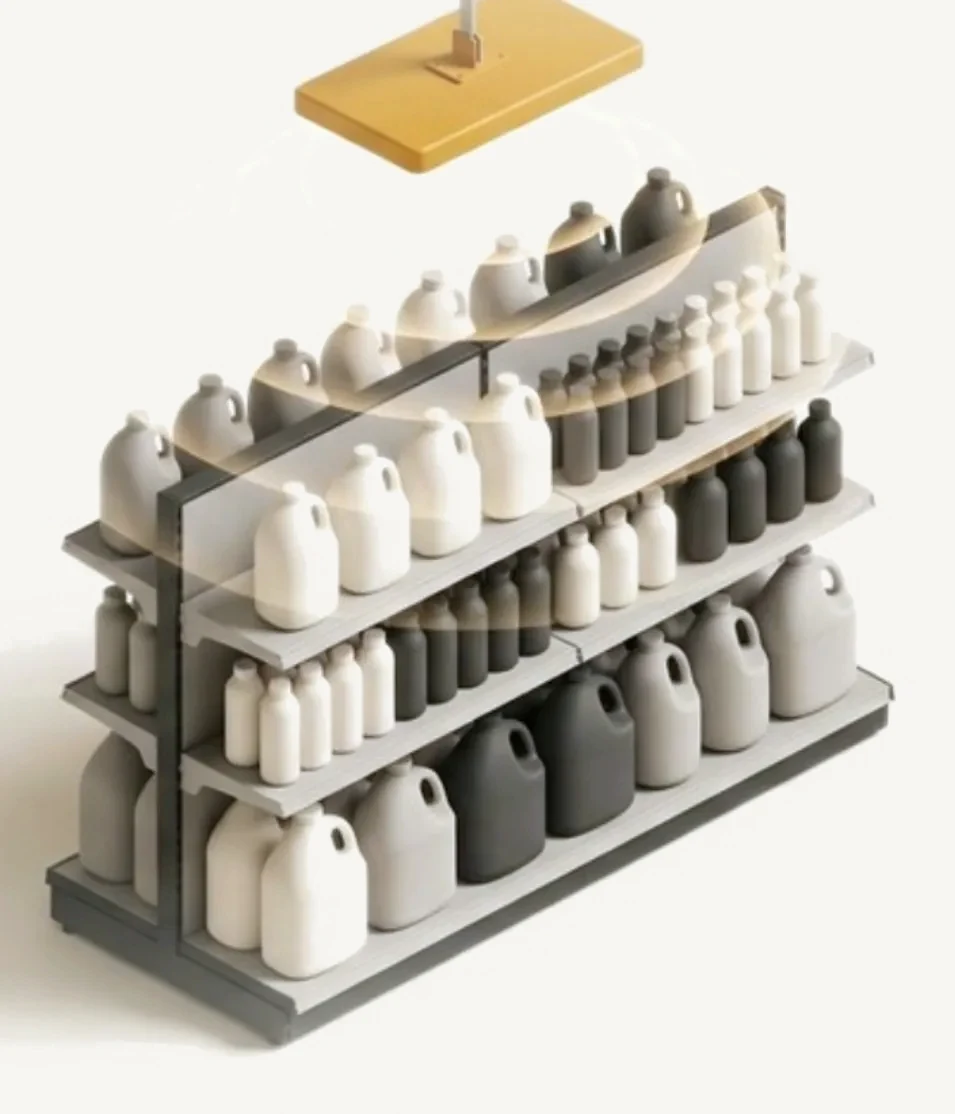
Fixed reader at 1 metre: items read in five seconds
15 percentage points more items read. Source: the companies’ own test.
Useful as evidence that the approach works. Not independent, and not a guarantee for your products.
One container type, about 50 containers, one handheld reader, and one distance for the fixed test. The write-up gives no sample size for the fixed test.
The write-up says reads improved at other distances too, but gives no figures for them.
If 89 of 100 items are read in five seconds, 11 are still to find. A longer read, a second pass or a different position may recover them. That is something to test.
What it could mean in a store
This is an illustration built from the test figures. It is not a result from any store.
Assume a store has 5,000 liquid items on the shelves, and a handheld reader keeps the test rate of 50 items per 10.6 seconds (standard) or per 5.1 seconds (Gen2X). That is 100 rounds of 50 items.
Counting time: about 1,060 seconds, or 17.7 minutes, in the standard mode. About 510 seconds, or 8.5 minutes, in Gen2X. At an assumed labour cost of $12 an hour, that is about $3.50 against $1.70 per full count of the liquids.
The point is not the dollars. At either figure, the cost of one count is small. What changes is how often a store can afford to count: a count that takes under ten minutes can be repeated far more often than one that takes a night. Real counts will be slower than the test, because aisles are crowded and shelves are not lined up neatly.
Per 1,000 tagged items, fixed reader, five seconds
Same test rates, scaled to 1,000 items for illustration.
Where it applies
The common factor is a liquid in a capped container, the format that standard tags have struggled with.
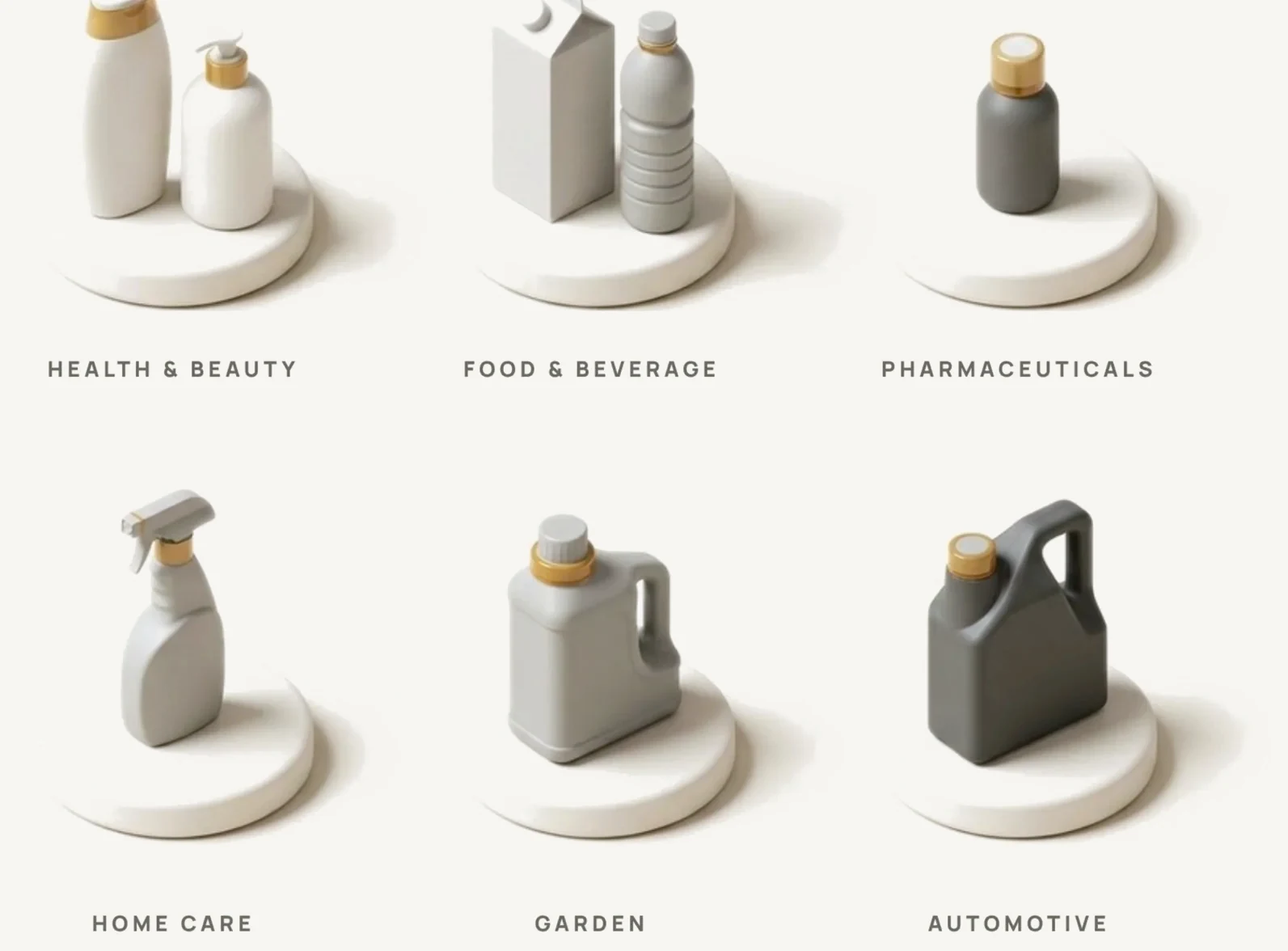
Retailers have been extending RFID into more of the store, and adoption is growing in health and beauty, food and general merchandise. A capped-container solution matters most where the same product is sold by the thousands: lotions and hand soaps, drinks, liquid medicines, cleaning sprays, garden treatments and motor oils. Products without a cap, such as pouches and cartons, would need a different answer.
An honest comparison
RFID is not the right answer for every shelf. Being clear about that is part of choosing well.
Question
A barcode is usually enough when
RFID starts to pay when
How often do you count?
Counts are rare, and one item is scanned at a time at the till.
You need frequent counts, or the whole shelf checked in minutes.
What is the cost of being wrong?
A small error does little harm, and stock is easy to find.
The system says one thing, the shelf another, and replenishment follows the wrong number.
Who handles the product?
One team, in one place.
Stock passes through several hands, sites or transfers.
What does the data feed?
A simple stock list.
Your ERP, warehouse or point-of-sale system, which should show what is physically there.
Either way, the count only helps if it connects to the systems you already run. A faster read that ends in a spreadsheet changes little.
Your shelf
You can judge the claim in a few hours with a short, honest test. Here is a method any operations team can follow.
Glossary
Plain meanings, for the whole team.
The family of passive UHF RFID that most retail and supply chain programmes use. Based on the Gen2 standard.
The international standard that tags and readers follow so that different makes work together.
An enhancement of Gen2 that improves sensitivity, speed and control. The full gain needs a supporting reader and chip.
A tag with no battery. It is powered by the reader’s radio energy.
The chip and antenna, before they are put inside a label, band or other form.
The thin plastic sleeve that seals the cap of a bottle. In this approach, it carries the inlay.
When the surroundings shift a tag antenna off its working frequency, so it cannot use the energy that arrives.
The share of tagged items a reader hears in a given time. 89% in five seconds means 89 of 100 items.
A handheld reader is carried by a person. A fixed reader is mounted at a doorway, shelf or dock.
Questions
Short answers. Where a question depends on your products, the answer says so.
No. It makes it harder. Water absorbs radio energy and detunes tags placed close to it, so the tag has to be positioned and designed with that in mind. The cap approach is one way of doing that.
A standard label wrapped on a full, round bottle is the situation that has caused problems. Labels designed for liquids, and tags placed at the cap, are being used to work around it. Test any option on your own products.
No. Most products keep their barcode. The tag adds a way to count many items at once without scanning each one.
To see the improvement shown in the tests, you need readers that support Gen2X. Existing readers will still read the tags, but the gain may be smaller. Ask your reader supplier what your devices support.
The write-up describes a solution for liquid-filled containers with caps. It does not claim to solve metal cans. Metal needs its own test.
It depends on the job. For a quick count, 89% in five seconds is a strong start, and a longer read or a second pass may find more. For a legal or audit count, you would want a method that confirms the rest. Test it on your shelf.
The write-up gives no pricing and no launch date. If the tag is applied at the factory, the cost sits with the manufacturer first, and how it is shared depends on the agreement between supplier and retailer.
With the products that cause you the most trouble today, in one store or one warehouse, with a clear before-and-after measure. Use the six-step method above.